|
Amid So Much War, How Do You Design A New U.S. Peace Center?$ d, G' V6 R, S/ q1 { We sat down with Moshe Safdie, the designer of the new United States Institute of Peace, to discuss the challenges of designing a would-be icon of peace in a time of war. With the UN in session, New York is abuzz with helicopters, sirens, sniffer dogs, and cabbies honking their frustration at the gridlocked traffic. In short, it’s as far as you can get from an atmosphere for peace. And that’s not even mentioning the UN’s architecture. As the delegates donned their earphones, we talked to architect Moshe Safdie about what makes a building "peaceful"--and his own United States Institute of Peace, which is scheduled to open next month on the National Mall. + y* B: Z8 A# e8 o: t' X' ^; s [/url]1 t1 d8 L A" ]; d Is the design of the UN conducive or detrimental to the idea of peace?8 R' x# S7 L7 F2 A The UN has a symbolic problem. It’s an [url=http://www.google.com/search?q=united+nations&hl=en&client=firefox-a&hs=rbs&rls=org.mozilla:en-US:official&prmd=imvnsu&source=lnms&tbm=isch&ei=In56TrbGHIP40gGiv-21Ag&sa=X&oi=mode_link&ct=mode&cd=2&ved=0CB4Q_AUoAQ&biw=1280&bih=588]office building abstracted into a simple form with hundreds of repetitive windows. Its message is that the UN is a uniform and unreachable bureaucracy. Even the assembly hall is a problem. It’s an object next to an obelisk. It doesn’t exactly radiate openness. 4 u( w: i( A; s( U How does your new U.S. Institute of Peace get around that problem? We tried to make it as extroverted as possible. The conference rooms, for example, are all visible--both from the inside, out to the city, and from the outside, into the building. + E6 A4 [/ [5 l* I. y" ` 9 r. L7 O V9 D Did you have the UN in mind as a model of what you didn’t want this building to be?% \+ m% O2 m9 w& } Actually, we wanted it to be the opposite of the Pentagon, a place where you never know what’s going on. 3 j: J* j5 J) {- }) o Still, peace often requires diplomacy, and that’s not always best done with everybody looking. # z( I3 N W0 d5 r* F/ `$ t While the building is extraordinarily open and transparent, there’s also a private entrance that’s secure. Also, since most of the researchers are working on things that are highly confidential, most of the offices are small and private--not like an open plan that you’d find in Silicon Valley. How did you bridge the gap between the need for privacy and the need for transparency?9 ^! a* e# I7 {$ U0 v/ S+ J0 w / O" y7 V) }$ J3 l4 K; l% j We created two atria. Half of the people working in the building have offices that look into one of the atriums, so they’re always aware of each other. That allows for both community and privacy. The people who work there say they’ve already noticed how the environment has changed their perceptions. They’re aware of being a part of a community of collaborators. You’ve said that you wanted the building to feel calm. How did you design in "calm"? I avoided jerky forms, and I used a lot of white--white glass, a white dome, a white envelope on the building. That all contributes to a sense of serenity. You had the advantage of a great site for this project. How did you maximize it? {2 R9 F. T- u2 Q# k& y# e I figured that if the Institute had the good fortune to get this unique site on the Mall, facing the Washington Monument, we needed to convey the notion that this building is situated in the capital of the United States. So we took every opportunity to frame views. One atrium looks out over Arlington Cemetery. One looks on the Lincoln Memorial. The conference room looks on the Capitol. 5 w, I0 ~4 i- X: u+ \; Y2 t You’ve also designed both Yad Vashem, the World Center for Holocaust Research, and the Yitzhak Rabin Center. Did either of those projects inform the design of this one?, {2 M N, f' D/ E4 n At Yad Vashem, I was most interested in building an environment that fostered a resonance between the architecture and the exhibits. At times, the audience seems inseparable from the photos on the walls. I began the Rabin Memorial after he was assassinated. It’s like a Presidential Library. He was, after all, the peacemaker, so I began by exploring roof forms. Also that building is about light--light within and light outside. Radiating at night, absorbing by day. I evolved that idea more strongly at the Peace Institute. [Search:DCION ) H6 _; ]) s9 Q* Z3 i2 y You were born in Israel, and lived in Canada before becoming a U.S. citizen. How did it feel to win this commission?4 }- S |3 H9 W/ m It was quite meaningful for me. This was, essentially, an American competition, not an international one, so when we applied for qualifications, I thought my origins might be a factor. I was already a citizen, but I was still strongly identified as an Israeli. When we won, I thought how wonderful it was that it didn’t seem to matter. And that an Israeli so committed to the peace process is connected with it really pleased me.2 R/ _9 ]+ @8 [. J% n' h |
精华推荐
换一换
发表评论1






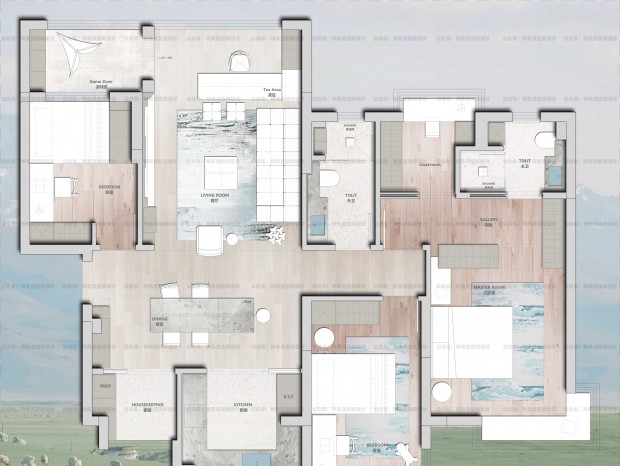


piaoguo,没明白这是效果图么?有模型没?